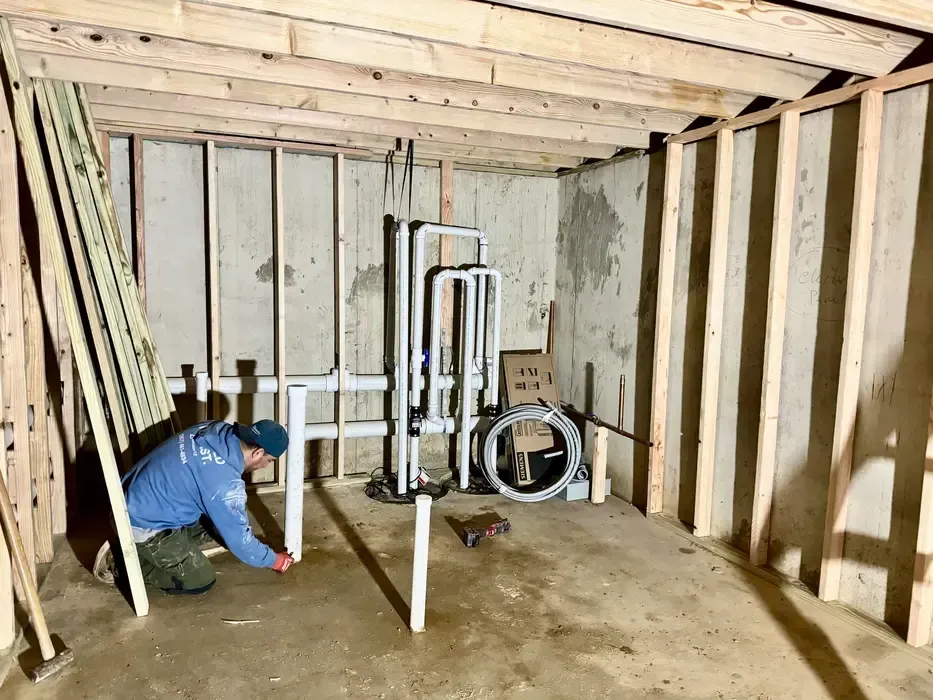
Basement vs. Addition: How to Decide in Philadelphia
The basement is the cheapest square footage you will ever add to your house. It is also the square footage an appraiser counts differently, the hardest place to put a legal bedroom, and the one part of the house where groundwater gets a vote.
An addition has none of those problems. It has a different set: a foundation, a roof, a zoning review, and a price tag several times higher.
Neither one is the better project. They solve different problems, and most of the regret comes from picking the cheaper one for a job only the other can do.
The side-by-side
Finished basement | Addition | |
|---|---|---|
What you're paying for | Finishing space that already has walls, a floor, and a roof over it | A new foundation, structure, roof, and exterior, then the finishes |
Published Philadelphia cost | $43 to $78 per square foot (HomeBlue) | $154 to $308 per square foot (HomeBlue) |
Daylight | Limited by how far the walls sit below grade | Whatever you design |
Yard | Untouched | You give some up |
Zoning review | Usually not the main hurdle, since the footprint doesn't change | Central to the project |
Biggest risk | Water | Budget and the tie-in to the existing house |
How appraisers report it | On a separate below-grade line | As above-grade living area |
What the published numbers say
HomeBlue publishes both figures for Philadelphia, which makes it a fair comparison, since both come from the same source and method. According to HomeBlue, finishing a basement in Philadelphia runs $43 to $78 per square foot, depending on features like bathrooms and wet bars. The same source puts a home addition in Philadelphia at $154 to $308 per square foot.
Per square foot, that puts an addition at roughly three and a half to four times the basement.
Put it on the same 400 square feet. HomeBlue lists a 20x20 room addition in Philadelphia at $62,000 to $123,000, depending on the grade of construction. Apply its basement range to the same footprint and you get about $17,000 to $31,000.
Two cautions. HomeBlue describes its own figures as approximate, and they are not Evolution 12 pricing. And the basement number assumes a basement that is ready to finish. If yours takes on water, the drainage work comes first and comes out of the same budget. We covered that sequence in what has to happen to a wet basement before finishing.
For county-level addition numbers, see our breakdown of home addition costs in Bucks County by addition type.
What a basement can't give you
The price gap is real, and so are the limits that come with it.
Daylight. A basement gets the windows its foundation allows. You can add light with good fixtures and paint, but you can't make it feel like a ground-floor room, and people use rooms that feel good to be in.
Ceiling height. Whatever is hanging below the joists now (ducts, drain lines, a beam) is hanging there for a reason. Some of it can move. Some of it can't. Measure to the lowest obstruction, not to the joists.
A bedroom. If the goal is a bedroom, ask your code office what it requires for a below-grade sleeping room before anyone draws a floor plan. The answer can change the budget, or change the plan from "bedroom" to "office."
A dry floor, guaranteed forever. Good prep manages water. It doesn't repeal it. Every basement finishing project should start with a hard look at where water has been and where it could go, and the finishes should be chosen with that in mind.
If your basement is dry, has decent height, and the room you need doesn't depend on sunlight, none of this is a dealbreaker. If two of the four are a problem, the low price is buying you a room you won't use.
Weighing both options? Request a free estimate and tell us you're deciding between the basement and an addition. It's easier to compare when one contractor looks at both.
What an addition costs you besides money
Yard. A ground-floor addition sits on land you're using for something now. On a tight Philadelphia lot, that may be all the outdoor space you have.
A zoning review. According to the City of Philadelphia, additions need zoning approval, and that approval is required before a building permit is issued. The city also notes that for smaller projects such as single-family additions, L&I can review zoning and building code requirements at the same time. Start with the city's page on zoning permits for new construction or additions. In Bucks and Montgomery counties, each township has its own zoning ordinance and its own office. Call yours before you pay for drawings.
An open house. At some point the new structure has to be cut into the old one. That means an opening in your exterior wall, trades moving through rooms you live in, and weather as a scheduling factor. A basement job mostly stays downstairs.
The tie-in. Most of the skill in a home addition is in where the new meets the old: rooflines, floor heights, siding or brick that has to match material that's been weathering for decades. Ask any contractor you interview how they plan to handle each of those. Vague answers there become change orders later.
Mechanical capacity. Your existing heating and cooling system was sized for the existing house. Have someone run the numbers on the added load instead of assuming it will stretch.
How the two are counted at resale
Many homeowners don't know this until they're selling.
According to McKissock Learning, an appraisal education provider, gross living area is the finished, above-grade living space of a home, and a finished basement that is wholly or partly below grade is not part of it. Under the measuring standard Fannie Mae follows, below-grade areas are reported as basement area, on a separate line of the appraisal.
That doesn't mean a finished basement adds no value. It means it's valued as finished basement, not as more house. An addition increases the above-grade number that listings and comparisons are built around.
How much either one returns depends on your block and your buyer. A local agent or appraiser can tell you what finished basements and larger floor plans are doing in your neighborhood. Ask before you choose, especially if you expect to sell within a few years.
Which rooms belong where
Strong in a basement: media room, home gym, playroom, workshop, guest space that gets used a few weeks a year, storage you can stand up in.
Better above grade: a primary bedroom suite, a bigger kitchen, a family room that's meant to be the center of the house, an office you'll sit in eight hours a day, living space for a parent who shouldn't be on stairs.
Could go either way: an extra bathroom, a teenager's hangout, a home office used a few hours a week.
The test is simple. If the room is somewhere you go for a specific activity, the basement works. If it's somewhere you live, it wants windows.
Decide it in one afternoon
Name the room. Write "a first-floor bedroom for my mother" or "somewhere for the kids to be loud," not "more space." Half the time the answer is obvious once it's written down.
Walk the basement with a tape measure. Check the height to the lowest obstruction. Look for stains, efflorescence, a sump pit, a dehumidifier that runs all summer.
Call the zoning office. In Philadelphia that's L&I, and the city says you can look up a property's current zoning on Atlas at atlas.phila.gov. In the suburbs, call the township. Ask what you're allowed to build on your lot.
Ask about a below-grade bedroom, if a bedroom is the goal.
Decide how long you're staying. A short stay makes the resale treatment matter more. A long one makes daily use matter more.
Get both scoped by the same contractor. Two bids from two specialists will each tell you their specialty is the answer.
Sometimes the honest answer is both, in order: finish the basement now for the space you need this year, and plan the addition for the room the basement can't be.
Get both options looked at
Evolution 12 is a licensed general contractor serving Philadelphia, Bucks County, and Montgomery County. If you're stuck between the two, schedule a free estimate and we'll tell you which one your house is better suited for, even when it's the smaller job.
About the author
Kanstantsin Bychak is the owner of Evolution 12, a licensed general contractor (PA License #PA164463) based in Huntingdon Valley, PA, serving Philadelphia, Bucks County, and Montgomery County.